Cuteness

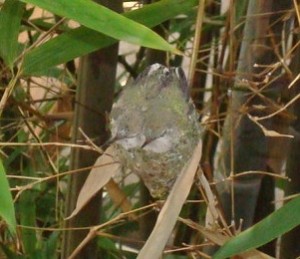
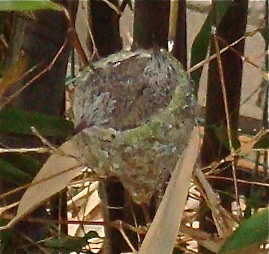
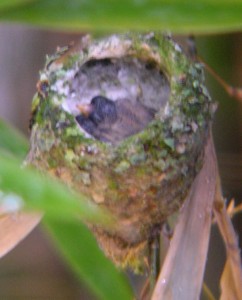
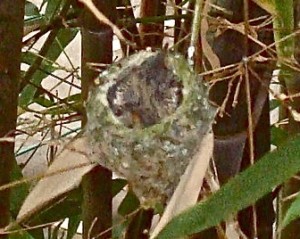
It’s getting crowded in the nest. You can pretty easily see them from the ground now, as they’re overflowing the edges of the nest.

two peas in a pod

two peas in a pod. Photo property of Green Dog Pet Supply

Yesterday they had noticeable new tail feathers, and mom is actively preening their wings each time she feeds them. The day before we had a big rainstorm and I went up to see how they were doing. I wish I could have captured it on film – both of them had their bills straight up to the sky, and they were drinking the rain with their little tongues flicking.

Meanwhile the other nest is growingnest2

She’s Already Building Her Next Nest!

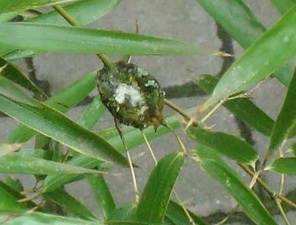
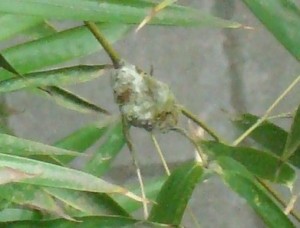
2nd nest, day 2 of nestbuilding

2nd nest, day 2 of nest building. Photo Property Green Dog Pet Supply

How interesting this all is! Yesterday (day 14 from first hatching) the mother started construction on her next nest in the other bamboo planter in our courtyard. I heard her fly in, so stopped to watch what I thought would be her hunting for insects for the babies. Instead, she landed on a branch and I saw her doing something that looked like preening her belly, but she came up with fluff in her beak and started jabbing it into a clump of something on the branch. I quickly realized that the little clump was a new nest – as if she isn’t busy enough feeding those two fat little hatchlings! It was interesting to me to see how much down she was working into what is essentially the base of the nest. Today I saw her fly in with nesting material, put it into the nest, add a bit more down, then fly over to the babies and feed them, then fly off again. Really so much energy she must be expending! However, it does seem efficient that by the time these babies fledge she’ll have a nest pretty much ready to go for the next clutch. When we originally noticed her building the first courtyard nest, someone had called the Audubon society to talk to them about it, and they said they thought it was probably her 2nd clutch of the season, as it was a little late for it to be her first. (they normally have 2-3 in a season). My books don’t mention whether they reuse the same nest, but this certainly answers that question. Makes me wonder if the first clutch was also somewhere in the bamboo and we hadn’t seen it. I’m reassured by her building this new nest right in the courtyard – she must not have been too put off by all of the spectators that we’ve created by pointing out this nest to so many people. We worried that we were going to create stress for her, even though she seemed relatively habituated (after buzzing us occasionally while we stood down below the first few days) to people looking.  Now I feel like she must really be OK with it or she wouldn’t have chosen the courtyard bamboo again. The good news is that this new nest seems to be even more in the open, so photography should be really a lot easier for this next clutch. Perhaps I will invest in a new camera…

Meanwhile, the babies continue to grow quickly and thrive. (Maybe she can’t reuse a nest because of how stretched out it gets from these big babies!) Actually, I suspect a fresh nest is about cleanliness for the health of the new babies.

day 13 from first hatchling's hatching

day 13 from first hatchling’s hatching. Photo property of Green Dog Pet Supply

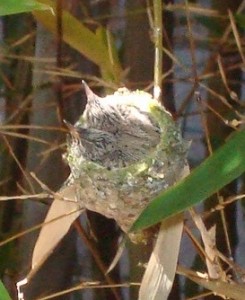
day 15 from 1st hatching

day 15 from 1st hatching is very crowded. Photo property of Green Dog Pet Supply

Today, more feathers, yellow disappearing from ever lengthening beaks, and first time I’ve noticed an eye open on hatchling #1 (I’m guessing which is which as one seems slightly ahead of the other, which makes a bit of sense as they hatched one day apart). We saw one of them flicking its long hummer tongue.

We Have Pinfeathers! Hummingbird babies growing up fast

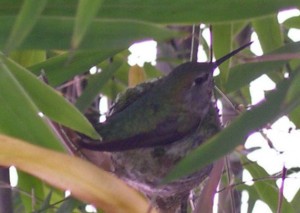
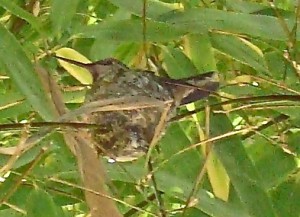
mother sittin on nest

mother sitting on nest. Photo property of Green Dog Pet Supply

It’s been fun to see how quickly these chicks are growing – every day they are noticeably bigger. We are on day 12 for the 1st chick, day 11 for the 2nd. They fill the nest almost to the brim, and their little heads are often propped up on the edge. When they squirm around, the nest expands and bulges. Their little beaks are starting to gain a little length, and I’m nearly certain their head feathers are green.  I can definitely see pinfeathers on their wings (which will be growing into real flight feathers soon – they fledge sometime between 18 and 23 days. Hard to believe!)

One very interesting thing I’ve noticed was the dramatic change in the mother’s behavior at about day 7. For the 1st 7 days, she sat on them all the time, leaving briefly to get food, feed them, and continue to sit on them. At about day 7 she seemed to be gone. A whole day went by without me seeing her. She still wasn’t there the next morning (it seemed) and I was so worried that something had happened to her. But when I went up and checked on the babies, they certainly were looking fat and healthy. So, I waited downstairs for a few minutes, and of course she flew right up and fed them (I could actually see their little heads poking up over the edge of the nest!) and immediately flew away again. Either they take so much work to feed, or she just doesn’t fit in there anymore. Probably a little of both, combined with the fact that they’re so “big” and fat that they can keep each other pretty warm by now.

I continue to be frustrated by my inability to photograph or even see them that well. My camera doesn’t want to zoom in close enough (even though they are so close – less than 6 feet away), and it’s so dark where they are. I’ve brought 3 pairs of binoculars to work, but none of them have been able to focus on something so close. Grrr. Here are a few photos that will hopefully give you an idea of what’s going on, but I promise to try and find another way to get good photos. Thanks to Gerry upstairs for the first 3 photos – he has a better camera than mine.

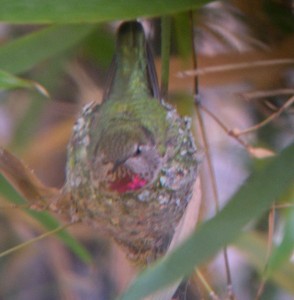
you can see her pink throat

you can see her pink throat. Photo property of Green Dog Pet Supply.

The first hatchling at 2 days old

The first hatchling at 2 days old – 2nd hatchling is closer to us, up against the wall of the nest. Photo property Green Dog Pet Supply

day 11 – you can kind of see how the beak is getting longer and the head feathers are green. Photo property Green Dog Pet Supply

A Little Springtime Happiness – Anna’s Hummingbird nest at Green Dog (note – updates added below)

hummer

We’ve had a terribly hard spring – a new software system being not the least of our troubles – working 7 days a week for multiple weeks, 10 and 12 hour days every day and not much end in sight. Then a sweet little gift – a hummingbird has decided to build her nest in the bamboo right outside of our door. From our position behind the cash register, Mike and I had both noticed a hummer zipping up into the bamboo quite frequently. So I stood out in the courtyard for a few minutes to try and see what a hummingbird could possibly want in a stand of bamboo. In she flew with a wad of moss in her beak and landed right on a little walnut sized nest. It’s been nice to watch her building and then lining the nest, but even more fun to share the experience with our customers. What a special treat to be able to see a hummingbird and her nest so very close – she’s only about 10 or 11 feet above us, in a nice spot – we can see her and point her out so easily. When she leaves to go eat, we can dash upstairs and peek into the nest to see the two little eggs she laid two weeks ago on a Sunday and Monday, smaller than Jelly Bellies. We should be seeing babies anytime in the next few days.

A few facts about Anna’s Hummingbirds (and a few photos of her eggs): They seem to be fairly common in the Portland area and are easily attracted to feeders. I often hear them before I see them – their call is easy to identify once you’ve heard it – kind of a a squeaking, grating, rapid little noise, given from a perch. They’re green on top and greyish below – the males are distinct from other hummers as they are the only ones with red foreheads as well as throats (the books call it red, but I see it as a metallic deep pink color, compared to the true red of a ruby throat). The females have more of a pink spot on their throat than other species. Their nests are a little cup made with plant down, moss, and lichen, bound together with spider webs, and lined with feather down.
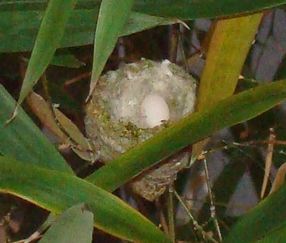
The first egg

The first egg. photo property of Green Dog Pet Supply
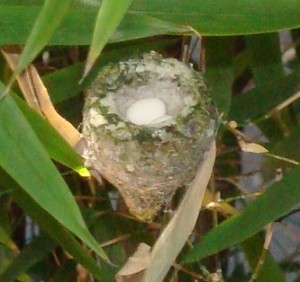
2 eggs in nest

2 eggs in nest. Photo property of Green Dog Pet Supply

The female does all of the work of nest building, incubation, and raising of the babies. She sits on eggs from 14-19 days, and babies fledge about 18-23 days after hatching. It was really interesting to notice that the nest was fairly shallow when she laid the eggs, and the whole time she’s been sitting on them, she’s been also adding moss and lichen to the edges of the nest, making it deeper and deeper. Now the walls are much higher, giving it a lot more room for babies to fit in there as they grow. We are eagerly anticipating the hatching – it’s been 17 days since she laid the first egg, so we know it should be any time between now and Friday.  Stop by soon and we’ll point her out to you. If this brood goes well, she will probably lay another clutch in this same area.

Update – later that afternoon, we had our first hatchling! Here’s a terrible photo – couldn’t even zoom in before mom was back and feeling very uncomfortable about us watching her – we backed way off, but could still see her feed it briefly before we ducked out completely:
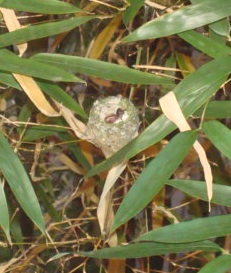
First photo of first nestling

First photo of first nestling. Photo property Green Dog Pet Supply

The next day we had nestling #2 hatch, right on schedule! Both seem to be doing well.

Day 3 photo – Here’s a better (but not great) photo of nestling#1 on day 3 (you can see its mostly naked body, its big eyes (closed for now) and yellow beak (short for now but will grow longer). It’s at least twice the weight it was when it hatched:
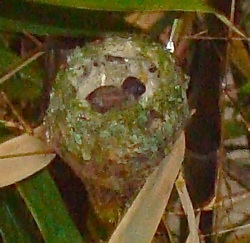
can see first nestling - #2 is up against the nearest nest wall so can't see it here

can see first nestling – #2 is up against the nearest nest wall so can’t see it here

Check out this slow motion video of a ruby throated hummingbird in flight (most N. American hummers flap at about 53 wingbeats per second.) hummingbird in flight

This is a good link to Hummer info and some neat photos of Anna’s chicks in a nest in their photo gallery http://www.hummingbirds.net/index.html

Some people have asked why we don’t put a feeder in the courtyard for her. The answer is because we don’t want to attract other hummers to the courtyard to bother her (they’re extremely territorial), and there is already a feeder across the street that she can visit. Also, at this age the nestlings are being fed mainly insects, not nectar.

See the next entry about these babies here