

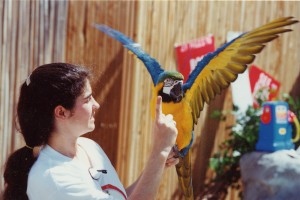
 Most of my posts are about cats and dogs of course, as that is our primary focus at Green Dog. But I know some of you have birds out there, and today I ran across a few videos about bird training that seemed to really have value – I thought I’d pass along a few to you. (and anyone that enjoys training any species at all can learn from these videos, as the concepts of positive reinforcement training are remarkably similar between species. I’ve trained a lot of animals, from orangutans to rhinos using these exact same techniques, and they work like a dream on dogs and even cats).
Though I wouldn’t personally choose to own a parrot, my work with parrots in the wildlife show/education dept at Zoo Atlanta taught me so much about the value and the mechanics of positive reinforcement training, and it made me respect the intelligence of parrots and especially their great need for mental stimulation. Parrots don’t do very well with down time – they’ve evolved to live in very complex environments, and their diet is incredibly varied, seasonally fluctuating, spread out over great distances. Not only that, but items in their diet are often difficult to process once they find them (hard shells, fruits with varying rinds and spiny protections, seeds embedded in plants, etc). Sitting around and eating chopped foods out of a bowl is certainly not how parrots are wired, and many difficult behavioral problems are born out of this sort of boredom. At the zoo we used enrichment techniques to introduce variety in their lives when they had down time in their cages, but most importantly we utilized positive reinforcement training programs. This was not only to develop behaviors that would ultimately help us bring educational messages to the public about parrot conservation in the wild, but more importantly to challenge and stimulate the minds of the parrots in our care.
First a fun one: Here’s a video of someone who has taught their parrot a fantastic array of tricks using positive reinforcement:
Even dog and cat trainers can use most of these tricks as inspirations for the types of behaviors you can train at home – pick up items and put them in specific places, position their body in unique ways, target objects, open and close doors, even match colors. (I once met a trainer who had taught her dog to sort light and dark laundry into two different baskets):
Then the mechanics of it all. I stumbled upon this woman that seems to really have made some good basic videos that would help to get a person started.
Here’s a link to the dos and don’ts of parrot training
Here’s a link about Target Training for birds
Target training can be the foundation for training lots of new tricks with any species of animal. I wrote an article about how we zookeepers used target training to introduce many species of animals to positive reinforcement training to help us care for them better. Click here
Training any animal is a perfect way to stimulate their minds and to develop a closer, more positive relationship with that animal. Animals with behavioral problems can truly be helped with positive reinforcement training, both indirectly by providing more stimulation, and directly by allowing you to address issues like handle-ability, food or object guarding, learning to choose calm behaviors over impulsive ones, etc. If you want tips about clicker training, the internet is loaded with them, and we also have some great books at Green Dog that will help you get started.