Kongs Are So Useful For Holidays!

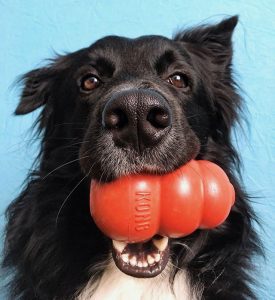
We know you know about Kongs (don’t you wish you’d invented them?) but we’d like to remind you that when your house is full of busy activities, and you have an irregular schedule and visitors, it can cause anxiety for the pets in the home. For dogs, one great calming activity can be working on extracting delicious foods from a Kong, and it has the added benefit of keeping them busy and therefore not underfoot. Chewing is also work, so Kongs can help on days when you just don’t have time to really run the dogs around as much as you’d like.

Kongs are one of the safest chews to give a dog, as they are made from natural rubber, are too large to swallow and are a good size to hold onto with their paws. Most people only think of smearing a bit of peanut butter inside, but you can be creative with other whole food Kong fillings to make them last longer and be even more appealing. (We don’t love the ingredients in the commercial fillings). Moist foods like plain yogurt, cooked sweet potato, a little cultured cottage cheese, banana, unsweetened applesauce, canned dog food, Green Juju or other finely minced greens/veggies, part of her regular serving of kibble  can be stuffed into the Kong and frozen to make them last much longer ((you can  soften it first in either water, fermented raw goat’s milk, or bone broth).

Pro Tips:

– Pick out a Kong that’s big enough for your dog’s tongue to reach inside and lick out the fillings.

– If you have a puppy, pick out a bigger one knowing they will grow into it but don’t load it all the way up with a full big Kong’s worth of food. It might be too much food. Remember that food can stimulate the need to poop for your puppy, so if you feed with a Kong in a crate, check on them before too long to take them out for a potty.

– For hard-chewing dogs, the black colored Kongs are even stronger than the red color.

Have You Heard Of A Catio?

By Christine Mallar

The Feral Cat catio tour in Portland has sold out again this year! What’s a catio? It’s an enclosed outdoor space for kitties that keeps them safe from harm’s way and protects much of the wildlife that is harmed by outdoor cats every year. Between 2-4 billion birds a and 7 -20 billion small mammals are killed by cats in the U.S. alone. The introduction of cats has caused the extinction of at least 33 endemic species on islands throughout the world.

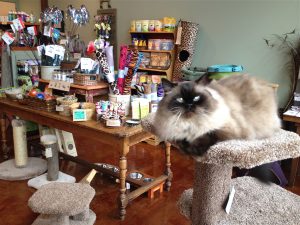
We of course adore our cats here in the U.S. and want them to be happy. I personally deeply respect their natural behaviors, and Mike and I try to meet Otis’ needs for interactive prey/predator simulation via interactive play every day. When we first adopted him at 10 years old, we were dedicated to turning him from an outdoor cat to an indoor cat – he had already been hit by a car in his lifetime, disappearing for a few days before showing up on the lawn and needing $5,000 in emergency surgery. He’s a fancy looking Himalayan with a laid back social nature, so he was stolen twice from his previous owner, and luckily recovered (one time by a friendly uniformed officer that was willing to mediate).When we met him he lived right near Green Dog, and started coming in our back door during the daytime and spending time socializing with all of us and our customers. Unfortunately, when he was outside, he was showing us how little he had learned about car safety by laying down for a bath right in the crosswalk on our busy street, or sprawling in the middle of a parking space along the side of the building. When he’d spot someone he wanted to visit, he’d just trot right through traffic to get to them. We felt like we had to save him from inevitable trouble with cars and luckily his owner was worried too and thrilled we wanted to take him.

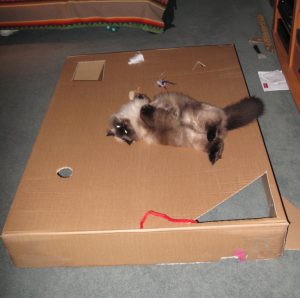
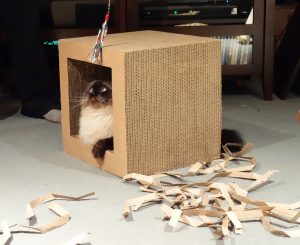
We committed ourselves to daily environmental enrichment for him (regular introduction of piles of paper to play in, boxes with holes of different sizes, bags, etc rotated through his play area). Being food motivated, he also enjoyed learning tricks for treats (he learned about 16 of them over time). The most important part of the puzzle was daily interactive play. Using toys to simulate the movement of prey animals that he could chase and hunt was key to keeping him satisfied as an indoor cat. The best interactive toy remains the “Da Bird” toy with its various attachments (sparkle, mouse and of course the spinning flying feathers). For really energetic catches, we’d give him a treat. For his very best most spectacular catch of the evening, we ran upstairs and gave him a 3/4″ piece of bony meaty raw chicken neck, which allowed him to “hunt”, “catch” and “eat a bird” in a a fairly awesome simulated way. It was truly satisfying to him. It also supercharged our play sessions, making him ultra-motivated to play every night and to run harder and faster. He knew that there was something in it for him! What we haven’t done for him yet but we aspire to is to build him some sort of catio.

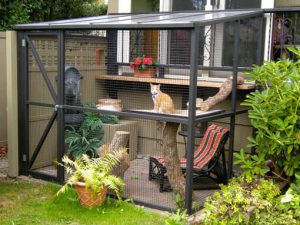
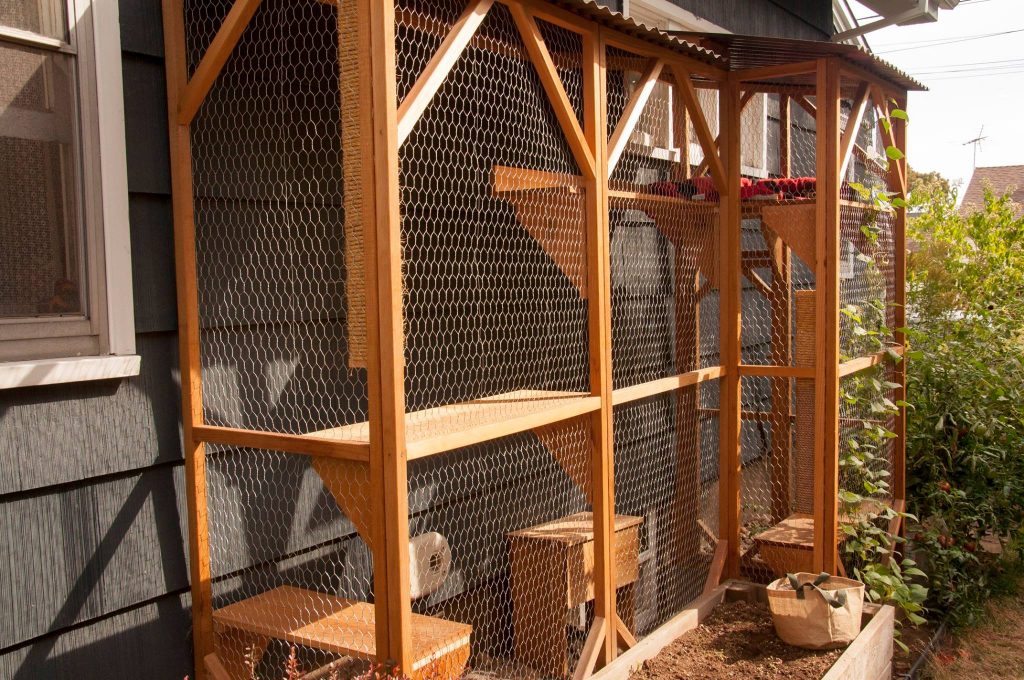
A catio is a structure (Cat Patio) that allows cats to be outdoors yet remain enclosed. It can be the simple modification of an existing porch by adding screening or mesh, it can be a structure built off of a window, or a tunnel system that they can travel through above the ground. It gives them the sights, sounds and smells of the outdoors, minus the risk. Even a small enclosure attached to a window can bring an indoor cat a lot of pleasure.

Can you imagine letting your dog out the door and into the city in the morning and saying “Have a good day! See you tonight! Hope you don’t get into trouble out there”? I can’t tell you how many stories we hear regularly in the store about losing their cats to coyotes, cars, infections due to fights, etc. Check out different catio designs online – you might be inspired!


Check out:
Cats Safe At Home

Google Image Search

Catio Spaces

Jackson Galaxy Cat Daddy Tips


#catio #feralcatcoalitionoforegon

Halloween Safety Tips

By Green Dog Pet Supply

Happy Halloween!10626878_10152327038381761_2622935969487730386_n

Halloween can be fun, but there are a few important things to keep in mind to help keep pets safe.

Beware of Toxic Things on Halloween

Don’t forget to be on guard for dogs getting into that Halloween Candy stash! Chocolate isn’t the only thing that’s toxic to dogs; macadamia nuts, raisins, and especially the sweetener xylitol are all on the list of things that can be very poisonous and sometimes deadly to dogs. Remember, the wrappers and other decorations can also cause problems when ingested. Check out this link to other common household items that are toxic to dogs, and what to do if your dog gets into them.

Behavioral Tips

Make sure that if your dog is stressed out by strangers to have him in a secure area of the house where he won’t be plagued by constant scary monsters ringing the doorbell. Conversely, if you’re up for it this is a great time to work on door manners with a dog that isn’t frightened, just excited. The doorbell rings, dog on leash sits, door opens, dog and costumed kid both get their own treats. Lots of repetitions available on Halloween equals lots of chances to practice how to act when people come to the door.

(more…)

Why we Discontinued the Sale of Retractable Leashes

When I was a trainer teaching classes I quickly banned these leashes from class time, as dogs can suddenly dash into the space of another dog that might have social issues.

This has continued to plague us at the store, as many dogs are reactive on leash or simply overexcited by other dogs. Some dogs are painfully frightened of being in a store to begin with, and being in close space with other dogs nearby can exacerbate this. When another dog on a retractable leash can quickly rush into their space, fights can break out. Stopping a fight is very difficult and dangerous if you can’t pull them out of the situation with their leash, and reaching in to remove the dog on a retractable leash would put the human in danger of being bitten. This also creates an unfair disadvantage for other people that are carefully trying to train dogs with social issues, as their ability to manage their dog’s space to keep their dog comfortable is destroyed easily by a dog that is suddenly 16 feet away from their owner and in that dog’s space. (some retractable leashes even go to 26 feet). It can be a huge training setback for these people who are trying to provide positive experiences for their dog in a place that contains other dogs within sight range.
Another problem for us is that when people are distracted by shopping, they may not notice when their dog is getting into trouble, eating treats on counter displays or marking our antique furniture (old wood is so porous!)
I do think there are some times that a retractable can add to the fun of an outing while still being “on leash” for safety, such as on the beach, or on a hike in areas that are not busy with people and other dogs, but please be aware that dogs leaving a trail at all in some habitats can damage fragile vegetation, etc.

The safety concerns for dogs and people are many when you use a retractable leash in a populated area. Even if your dog is tiny and wouldn’t break a leash, wouldn’t it be terrible if an off leash dog attacked your little dog and it was 16 or more feet away from you when it happened? Please read these ten reasons below before deciding to use a retractable leash. Remember: if you use a retractable leash, keep it retracted and locked so it is as short as or shorter than a regular leash in places with other dogs and people. When you are in an open space, you can give them more room to explore. If you are looking to buy a retractable leash for trips to the beach, find one with a “belt” or “tape” instead of a cord. This can be safer for your skin.


10 Reasons Not to Use a Retractable Leash

1.  The length of retractable leashes, some of which can extend up to 26 feet, allows dogs to get far enough away from their humans that a situation can quickly turn dangerous. A dog on a retractable leash is often able to run into the middle of the street, for example, or make uninvited contact with other dogs or people.

2. In the above scenario, or one in which your pet is being approached by an aggressive dog, it is nearly impossible to get control of the situation if the need arises. It’s much easier to regain control of – or protect — a dog at the end of a six-foot standard flat leash than it is if he’s 20 or so feet away at the end of what amounts to a thin string.

These tape and string flexi leashes come with safety warnings. From their website:

  • If the cord runs across your skin, it can cause
    abrasions (like a rope burn) or severe cuts. Cuts and burns are more likely if the cord wraps around any part of the body”.
  • Avoid contact with the cord and never let it wrap around any part of your body.”
    • “Do not allow slack to build up in the cord – you might get tangled in the slack”.
    • “Do not touch the cord if the cord wraps around you. Turn around or pass the handle from one hand to the other to unwrap yourself. (See “Finger Amputation and Fractures”)
    • “If you want to further reduce the risk of cuts and burns, you can wear long sleeves and pants to protect your arms and legs”
  • If the leash or your dog’s collar breaks, or if the leash disconnects from your dog’s collar, the cord and hook can snap back with enough force to cause serious eye damage, broken teeth, cuts, and bruises. If the cord is under enough tension, this can happen even when the leash is locked”.

When the leash is fully extended, it can be very difficult to get your dog back to you safely, as pulling on the cord with your hands makes you vulnerable to injuries. See This link for a photo of the nasty injuries these cords can inflict on your legs/arms

The thin cord of a retractable leash can break – especially when a powerful dog is on the other end of it. This can endanger the dog, and can also result in an injury to the owner.

Dogs necks and spines can also be injured by the sudden jerk if they run all the way to the length of the leash, hitting the end. Owners should be aware that the bulky handles can be pulled out of your hand when this happens as well, especially if your dog is suddenly running. the sound of the plastic handle bouncing on the pavement can really frighten the dog who is running away, as if they are being chased by it).

Retractables can train a dog to pull on their leashes, as pulling is what extends the leash.

I had a customer who had gotten a nasty injury to her fingers by a cord, and then I was bitten by a small dog whose owner was leaning into her car to get things organized. I was jogging by and the dog dashed after me, the long flexi allowing her to reach me and bite my leg.
After that, I decided it might be time to write this blog post, and encourage the use of extendable leashes be restricted to large outdoor spaces. I would certainly use one on a big uncrowded beach that requires dogs to be leashed. We still will order these leashes for people who want them, but we did decide to take them off of our store shelves.


 

Happy Halloween – a Few Tips

By Green Dog Pet Supply

Happy Halloween!10626878_10152327038381761_2622935969487730386_n

Halloween can be fun, but there are a few important things to keep in mind to help keep pets safe.

Beware of Toxic Things on Halloween

Don’t forget to be on guard for dogs getting into that Halloween Candy stash! Chocolate isn’t the only thing that’s toxic to dogs; macadamia nuts, raisins, and especially the sweetener xylitol are all on the list of things that can be very poisonous and sometimes deadly to dogs, but the wrappers and other decorations can also cause problems when ingested. Check out this link to other common household items that are toxic to dogs, and what to do if your dog gets into them.

Behavioral Tips

Make sure that if your dog is stressed out by strangers to have him in a secure area of the house where he won’t be plagued by constant scary monsters ringing the doorbell. Conversely, if you’re up for it this is a great time to work on door manners with a dog that isn’t frightened, just excited. The doorbell rings, dog on leash sits, door opens, dog and costumed kid both get their own treats. Lots of repetitions available on Halloween equals lots of chances to practice how to act when people come to the door.

Hints:

-Practice this a day or two beforehand with someone familiar that rings the doorbell, rehearsing the routine 8 or 10 times of sitting quietly before the door opens, and staying calm with the help of treats to keep attention on you and reward the good behavior (the first time is hard, then it gets easier as they’re seeing the same person over and over. This lets the dog get better and better at the behavior because you’ve removed the novelty of someone at the door)
– work on a leash for control, but reward the sitting calmly without lots of yanking. Remember, the familiar person can hang out on the step for a few minutes while you work on achieving a sit or at least calm attention before you open the door.
– On Halloween, have two people work the door, one for kid treats and one for working with the dog
– When the doorbell rings, don’t jump up. Walk calmly to the door, and practice these skills of staying calm while people are greeted.

If you have a new puppy this can be a good socialization exercise: monsters = good treats for puppy! First put on masks or hats several times in the few days before Halloween, but don’t act scary, just be yourself and encourage your puppy to come get treats and interact with you in this strange get-up. Do multiple repetitions at different times until your puppy isn’t reacting fearfully. On Halloween night, encourage them to say hi to the funny monsters, but don’t force them into it – you want socialization exercises to be positive. Offer your puppy really delicious treats like bits of cheese while they interact with the people in costumes, and if you feel like it’s safe, have the monsters offer the puppy some yummy dog jerky or pieces of cheese. Soon the puppy will think people in costumes are a good thing!

Other things to keep in mind:

– Make sure all of your pets are wearing i.d. tags, even your indoor cats. That door is opening and closing many times during that evening, giving opportunities for your pets to slip out.

– Watch out for candle flames – often there are decorations that might be novel to the pet who wants to investigate them.

– Keep indoor/outdoor cats inside for the night – you do hear strange and terrible stories sometimes of cats who are the victim of cruel treatment on this night.

Fun Stuff
check out this link to cute dog breed stencils for your pumpkin carving! Each one can be downloaded by clicking a link under the description

Tips for New Puppy Owners

10329266_10152016183111761_227844732552835172_n

By Green Dog Pet Supply

(This was written as a handout for customers, and we thought it might be useful to others as a blog post. If you share it, please give credit to Green Dog Pet Supply. Thank you)

Congratulations on your new puppy!DSC01291

What a fun time you’ll have! We very much want your new baby to live a long, healthy, happy life, so we thought we’d compile some of the nitty-gritty dos-and-don’ts of puppy care. We want to be a resource for you as you take this journey, so please don’t hesitate to ask questions if you have them, and if you live nearby feel free to visit often just to say hi, get treats and love from our staff, and to socialize your puppy – we love to see you!
Here are a few tips that we hope will come in handy for you:


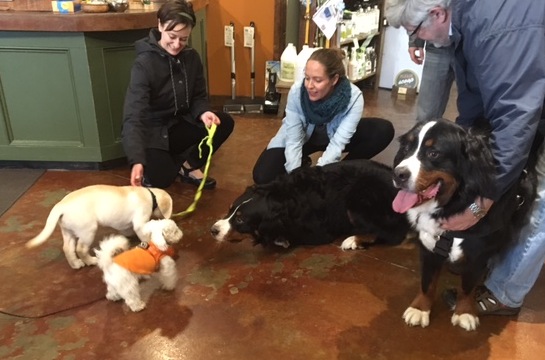
it's very nice when big dogs get low to meet puppies. Hold the adult dog in one place on a leash and allow the puppy to approach and retreat as they gain confidence.

It’s very nice when big dogs get low to meet puppies. Hold the adult dog in one place on a leash and allow the puppy to approach and retreat as they gain confidence.

Socialization is of utmost importance. Though we realize that it’s important to keep your puppy physically healthy, there are definitely also big behavioral risks to keeping your puppy away from the world for too long. Puppies only have about a 4 month window of opportunity for their primary socialization to occur. Beyond that, it becomes harder to convince them that the world is a fun and inviting place. One of the primary reasons that dogs are given up to shelters is for difficult behavioral issues. Fear aggression towards strangers, reactivity around other dogs, and trouble relating to children are issues that may be prevented with better socialization early in life. Well socialized dogs are a pleasure to bring out into the world and lead calmer, less fearful lives. If you’ve adopted an older puppy and they’re a little nervous about the world, don’t worry – significant strides can be made with positive reinforcement training! Your major goal with all new dogs is to try and create as many positive experiences with new things (or with things they already find worrisome) as you can, and to not push them into anything they don’t feel comfortable with. Be their cheerleaders and they’ll gain confidence.
We strongly recommend a puppy class, whether this is your first or your 10th puppy. Classes are a wonderful way to expose this new puppy to the many other shapes and sizes of dogs, and give them early positive playtime experiences with other dogs under the watchful eye of a trainer in a clean environment. If you do a class together as a family, everyone in the household gets to hear the same instructions (which is great for preserving family harmony) and everyone can work together as a team to work on new behaviors (great for kids to have a mission). Best of all, you have access to the same trainer for the duration of the class – a great resource for the little problems that can pop up. A class also gives you the unique opportunity to work on behaviors in a distracting environment (if they can practice focusing on you with puppies and people all around them, they can learn to do it anywhere!) Most puppy classes allow a puppy to enter class by about 10 weeks of age as long as they are current with their vaccinations for their age, and we say the sooner the better. It’s far easier to prevent problems than to try to fix them later, and it’s often a big help to have the advice of a trainer in the early weeks where patterns of behavior in the home are being established. Ask us for referrals to great classes in our area. There are also a few places in town that have socialization play groups just for puppies!

(more…)

Thundershirts Can Be an Amazing Tool to Help Fearful Dogs

by Green Dog Pet Supply

thundershirt

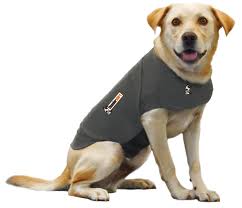
I was busy writing a blog posting on July 4th tips, but I felt like the section I was writing about Thundershirts deserves its own post, as we’ve been so very happy with the results we’ve seen with this product. Though they don’t help every dog, the number of great stories we hear from customers about how well they work on dogs with anxiety issues is very impressive. It’s a sort of jacket that is wrapped snugly around a pet and secures with velcro, and it has amazing calming effects on many anxious animals. (more…)

What the Heck is Target Training?

A Tapir learns to touch a target in a zoo

A Tapir learns to touch a target in a zoo

By Christine Mallar

We just brought in some nifty extendable target training sticks to the store, and so I thought I should write up a description of what it’s used for, as targeting is such a fun and really easy activity to do with your pets, no matter what species – I’ve even taught a fish to target. No, seriously! This isn’t an indication of what a good trainer I am, it’s just an illustration of how easy it is to teach and learn this behavior. (In fact, I have to laugh as I just Googled “Target Training a Fish” and came up with lots of results! Here’s one).

To ask an animal to target, you are asking the animal to deliberately touch an object, and you are marking the moment with a sound (like a click from a training clicker, or even the word “Yes!”). The animal knows this sound means that a treat is coming their way, and allows them to pinpoint the exact thing the trainer wants them to do to earn that treat.  This clever concept was created by dolphin trainers. Dolphins are very smart, but slippery. Trainers couldn’t possibly have used traditional methods of training that required physical domination of the animals (like cowboys did with horses, or dog trainers did with leashes and choke collars) – it just isn’t possible. With a whistle and a bucket of fish, dolphins participated voluntarily in their own training (and if they weren’t having fun they could easily swim away).

Picture this: a dolphin trainer wants the dolphin to jump out of the water and touch a ball that is suspended way up high. First, the trainer might toss the ball onto the water and wait until the dolphin investigates it. The trainer is watching for the moment the dolphin touches the ball with its nose, and they mark that moment exactly with a whistle. This noise means a piece of fish, which the dolphin happily goes to collect from the trainer. When the dolphin happens to touch the ball again and hears that whistle, it starts to become quite clear to the dolphindolphin that she can touch that ball on purpose to make that trainer give her another fish. Now that the intent is clear that the behavior is to touch the ball with her nose, the trainer can introduce a hand signal or word right before she touches it, which becomes the command. The trainer might suspend the ball from a rope right at water level, and ask for and whistle/reward touches to the ball. Then the ball can be raised a little at a time and the dolphin must now stretch to reach it, and then jump to reach it, etc. Targeting can also be used to teach her to touch other parts of her body to objects or even a trainer’s hand, allowing the trainer to perhaps shake a flipper (first a “trick”) and then this trick is used to slowly shape a far more difficult behavior, like allowing a vet to take blood from a vein on that flipper – all with voluntary participation from that dolphin. It removes the fear of that procedure as it’s taught gradually, and is certainly easier and much less risky for everyone involved than corralling that dolphin and herding her into some sort of restraint device that would enable them to get that blood sample forcefully, and good luck getting that done a second time! With positive reinforcement training, it became possible for trainers to get voluntary participation from the dolphins for complex behaviors like veterinary procedures, helping to greatly lower the stress for the dolphins if they needed care.
(more…)

Training a Cat

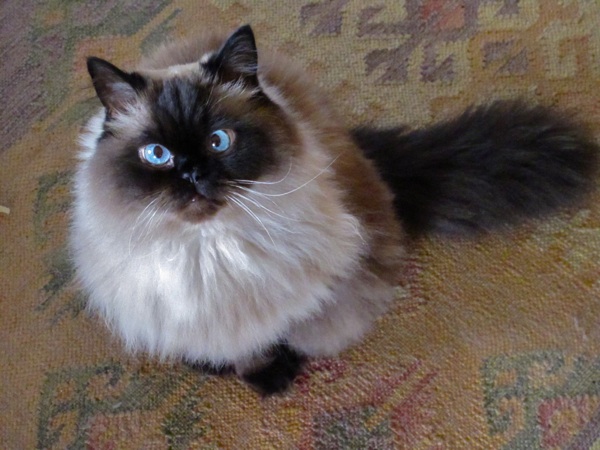
otisblueeyesThere’s a lot of cat stuff on our minds these days as we’ve recently adopted a 10 year old Himalayan cat.
So many people think that cats don’t need anything – we hear this all the time. They seem to understand that dogs need interaction, exercise and mental stimulation, but cats, (especially indoor cats) need these things as well. One thing we hear a lot from the people who think their cats don’t need anything is how horrible their cats’ behavior is and how destructive these cats are to their home!
We needed to teach Otis a lot of new things when we brought him in, as we were turning him from an indoor/outdoor cat to an entirely indoor cat, so making sure he was good at a litter box and scratching posts and keeping him stimulated enough to make up for his outdoor time was all important. I thought it might be fun to share a few videos with you.
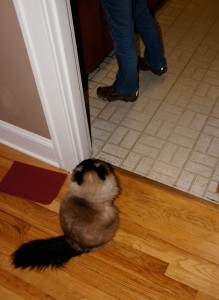
Cats can certainly be trained through positive reinforcement techniques to follow commands. He’s got a pretty good recall and he sits like a champ on command. I also needed him to get the heck out from under my feet in the kitchen – I decided to use the threshold of the kitchen as a visual marker; something easy for him to understand. Get over the threshold and stay there and the treats you seek will come to you:
<iframe width=”560″ height=”315″ src=”https://www.youtube.com/embed/g8StgvhBxzg” title=”YouTube video player” frameborder=”0″ allow=”accelerometer; autoplay; clipboard-write; encrypted-media; gyroscope; picture-in-picture” allowfullscreen></iframe>

It’s been working well. First I lured him with a treat into the spot, while I said the command, then I started saying “get in your spot” and then luring and rewarding him, and then I would say the command and pause before luring him. It took longer than it would have taken a dog, but he eventually had that “Aha moment” and did it himself. Now, he needs to stay in the spot for longer and longer periods to get treats.

spot

He had a history of being brushed and liking it in the past (you have to brush a Himalayan!) but when he came to us he didn’t tolerate it much. Mostly he wanted to play and bite the brush, and forget about brushing anything but his cheeks and back. So, we started with what he would tolerate, and just when he was doing a nice job, we’d stop and get a treat. Of course over time he’d tolerate a bit more and a bit more. I’d try to reward it when he did a slightly better job than usual, and if I pushed it too long and he got cranky/silly about it, I just stopped and left.
Each time he rolled over on his back (even when he wasn’t being brushed) I’d use the word “belly” while I talked to him, and if he let me touch and later rub the belly (without snapping the bear trap shut – our name for the attack we’d often get if we touched it) I’d give him a treat. We’ve gotten pretty far and I was impressed when he started making the connection for giving up the belly when I asked for it:

Any pet can learn to tolerate and eventually enjoy things they don’t like using this same process. Nail trims, handling body parts they don’t like touched, and being brushed are just three practical examples. You have to start with something they do tolerate or even enjoy, even if that means that you have to start with something that hardly looks like the behavior you want to achieve. Building up slowly is the key – even the tiniest progress is worth rewarding, and never ever forcing something they’re uncomfortable with. Here’s another post about this process. It’s worth working on! If you ever want to talk to me (Christine) in more detail about your specific challenge, please do come in and I’ll try to help you with some tips