



A Tapir learns to touch a target in a zoo
By Christine Mallar
We just brought in some nifty extendable target training sticks to the store, and so I thought I should write up a description of what it’s used for, as targeting is such a fun and really easy activity to do with your pets, no matter what species – I’ve even taught a fish to target. No, seriously! This isn’t an indication of what a good trainer I am, it’s just an illustration of how easy it is to teach and learn this behavior. (In fact, I have to laugh as I just Googled “Target Training a Fish” and came up with lots of results! Here’s one).
To ask an animal to target, you are asking the animal to deliberately touch an object, and you are marking the moment with a sound (like a click from a training clicker, or even the word “Yes!”). The animal knows this sound means that a treat is coming their way, and allows them to pinpoint the exact thing the trainer wants them to do to earn that treat. This clever concept was created by dolphin trainers. Dolphins are very smart, but slippery. Trainers couldn’t possibly have used traditional methods of training that required physical domination of the animals (like cowboys did with horses, or dog trainers did with leashes and choke collars) – it just isn’t possible. With a whistle and a bucket of fish, dolphins participated voluntarily in their own training (and if they weren’t having fun they could easily swim away).
Picture this: a dolphin trainer wants the dolphin to jump out of the water and touch a ball that is suspended way up high. First, the trainer might toss the ball onto the water and wait until the dolphin investigates it. The trainer is watching for the moment the dolphin touches the ball with its nose, and they mark that moment exactly with a whistle. This noise means a piece of fish, which the dolphin happily goes to collect from the trainer. When the dolphin happens to touch the ball again and hears that whistle, it starts to become quite clear to the 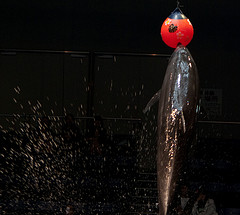 dolphin that she can touch that ball on purpose to make that trainer give her another fish. Now that the intent is clear that the behavior is to touch the ball with her nose, the trainer can introduce a hand signal or word right before she touches it, which becomes the command. The trainer might suspend the ball from a rope right at water level, and ask for and whistle/reward touches to the ball. Then the ball can be raised a little at a time and the dolphin must now stretch to reach it, and then jump to reach it, etc. Targeting can also be used to teach her to touch other parts of her body to objects or even a trainer’s hand, allowing the trainer to perhaps shake a flipper (first a “trick”) and then this trick is used to slowly shape a far more difficult behavior, like allowing a vet to take blood from a vein on that flipper – all with voluntary participation from that dolphin. It removes the fear of that procedure as it’s taught gradually, and is certainly easier and much less risky for everyone involved than corralling that dolphin and herding her into some sort of restraint device that would enable them to get that blood sample forcefully, and good luck getting that done a second time! With positive reinforcement training, it became possible for trainers to get voluntary participation from the dolphins for complex behaviors like veterinary procedures, helping to greatly lower the stress for the dolphins if they needed care.