Tips on Avoiding Separation Anxiety, Handling, Soft Mouths, and Socialization During Covid
Hello new dogs!
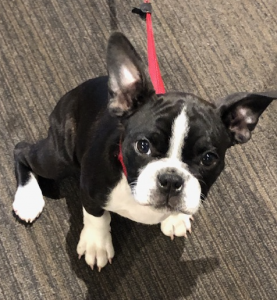 We’ve seen a surprising number of customers with brand new puppies in the store these past few weeks! There are also reports of shelters getting cleaned out of both cats and dogs around the country – yay! But Why? I was a little surprised at first, but I quickly realized there were two good reasons. What I heard from customers was that they thought that with all of the time they had on their hands, they could really concentrate on training a puppy. Later I also started to realize that this is a very scary time. All of us feel frightened and unsure of how long we’ll be living in this strange, suspended, frightening reality. A new dog or cat is not just a delightful distraction from boredom- that little soul can really be a life raft for your psyche. When a puppy comes into the store right now, we’re incredibly grateful for the visit – it helps us have a moment of sweetness and laughter in our crazy upended lives of scurrying around putting together orders for curbside pickup, interacting with most people by phone and trying to get the people who are visiting in and out quickly (we do allow two people in the store at a time right now). We stop for a moment and soak in the puppiness. I can see both the logic and the emotional benefits of this decision for sure. But, this new-puppy-during-quarantine situation does come with a few unique challenges.
Challenge #1: Separation Anxiety is a Risk For The Future
Being home all day every day with a new dog sets up a tricky precedent: What will happen when you 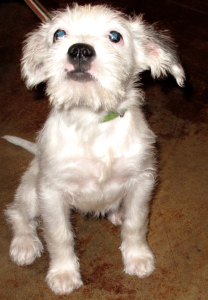 suddenly are allowed to go back to work? Adult dogs that are rescued are often prone to some degree of separation anxiety. If you think about it, it’s not an unfounded fear – they probably had another owner, and for whatever reason, lost that owner. They must worry constantly in the early days after being adopted that it could happen again. They’ll often hyper-bond to their new owner after the loss of the old one, sticking like glue to them in the house. When that new owner suddenly goes to the grocery store, the dog left behind might feel a great deal of stress.
A new puppy thinks that the routine you have in your home from the beginning is what is “normal”. Having that routine change suddenly could really throw them for a loop as well.
The most important way to prepare these dogs now for this eventuality is to show them that sometimes you leave, and yet you always come back. Showing them that you coming and going throughout the day is “normal” and doesn’t mean anything bad. First start with very short absences. Pick up your keys, step out the door, one Missisippi two Missisippi, step back in, put the keys down and go about your business indoors. Don’t make a big deal about leaving or coming back. Do that a lot until the dog doesn’t even really notice what you’re doing.
Then you can continue to build time by a little bit until you can stay outside for a few minutes. Each time, don’t mention you’re leaving, just take your keys (and whatever you’d leave with if you were going shopping). When you come back in, don’t make any sort of big deal. Jut say hi and go about your business.
At this point, you can start to work on confinement when you leave. First decide where the place is that they will stay when you’re gone. Crate training from the beginning can be helpful, or acclimating them to staying in a place like the kitchen (somewhere without rugs or lots of things to destroy). Using baby gates or 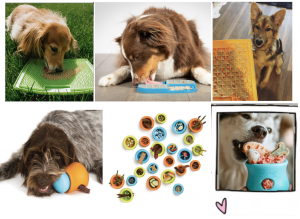 an Ex-pen can be helpful. Link the confinement to a pleasurable activity like working on a treat-stuffed puzzle/slow feeder toy (Toppl, Kong, Kong Wobbler, or Lickimats are our favorites – fill the Toppl/Kong/Lickimats with moist foods and freeze them! Fill the wobbler with kibble sized dry treats or foods). You might even feed them most or all their meals in this way, so that they look forward to being confined briefly as part of their day. Remember that puppies often need to relieve themselves after a meal, so take them out of confinement and outside right after mealtime. Once they’re relaxed about your short comings and goings and also happily getting into confinement, combine them: Put them in confinement with a little puzzle toy or safe chewy before you go outside.
Eventually, take a walk around the block without the dog, or take the car around the block. Then come back (without fanfare) and perhaps take them out for another walk with you.
Is your dog a real velcro dog that can’t seem to be relaxed when you’re not right there? Some tips:
– increase the amount of exercise she gets, especially before you leave.
– consider agility training or other dog sports to increase her confidence and mental stimulation
– work on behaviors that involve a little distance, like stay, fetch, nose work, or hide and seek, to help her see that fun can happen when you’re a little ways away from her.
– install baby gates in multiple places in the house and leave good toys and treats/stuffed puzzles nearby, so that each time you leave her in a room as you walk around your house she gets something positive.
– Work on your “go to your spot” behavior, creating a safe spot to rest and a good habit of being able to settle down there without being pressed up against you – read how here (scroll down to Strategy #4)
– Often velcro dogs are being reinforced by you for sticking by you without you realizing it. When you go somewhere, you might be talking to her, petting her a bit, dropping crumbs in the kitchen, etc. When you make a move to get up from the couch (like holding the remote to turn off the TV) the dog might jump up anticipating your next move. Working on go to your spot while you sit down and being released from the spot when you get up and walk to her would be a good thing to work on. You can also start picking up the remote and putting it down numerous times while you watch TV, and then start to include standing up and sitting back down, etc which can decrease her anticipation of your next move so she doesn’t see it as a predictor anymore.
Challenge #2: Socialization
This is a big one of course. Socializing a new puppy or helping a newly adopted nervous dog warm up to people and to new sights and sounds are some of the very most important things that you have to work on when you bring a new dog home. This is an obvious challenge when you’re not supposed to be taking excursions or spending time with people outside your household, but it’s not impossible.
At this time, the CDC, the World Health Organization (WHO), and the World Organization for Animal Health (OIE) say there is no evidence that companion animals, including pets, spread COVID-19.
Here’s some good info about that one weird thing we heard about the dog in China.
Can your pet infect you? To quote National Geographic’s Rachel Bale, “Yes, a tiger at the Bronx Zoo tested positive for the novel coronavirus. And yes, a cat in Belgium had traces of the virus’s genome in its stool and vomit.
But to be perfectly clear: There is no evidence that pets can spread COVID-19 to people. One study, from a veterinary diagnostic lab, tested thousands of samples from dogs and cats, and found no cases of the disease. And an early version of a report on a small experiment testing whether the virus could spread between cats found that it can—but it does not suggest that cats are an important vector in spreading disease among humans. With more than 1.4 million cases of COVID-19 globally, experts say that if pets were a significant vector, we’d know by now.
“This is almost exclusively a human-to-human transmitted disease,” Michael San Filippo, a spokesman for the American Veterinary Medicine Association, told NBC affiliates. “The risk to pets is very low, with only a handful of cases of the virus appearing in companion animals, and no cases of people getting sick from their pets.” We at Green Dog believe that if someone has the virus, it is quite conceivable considering this news from Bronx zoo that a cat could get it and show symptoms. The British veterinary Association is suggesting that cats be kept indoors to protect their health. We hesitate to recommend that you limit your puppy’s socialization with people and dogs, as we believe the risks that come along with a poorly socialized dog outweigh the very low risk of transmission of the virus from a dog to a human or another dog. If you are sick with Covid 19, it makes sense to protect your animals from you the same way you would protect other people, restricting your contact with them.
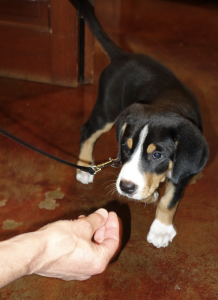 Bring treats with you on your walks. If the dog is startled by any weird sights or sounds, be upbeat, offer treats, and jolly them out of that bad feeling. “Wooo! That was a big funny dump truck wasn’t it!” is better than consoling them in a way that makes them think you also find that dump truck big and scary. Use your happy voice and manage their space if your dog is very nervous. Bring a treat pouch with you on your walks. Pairing yummy treats with the presence of something/someone that makes them uncomfortable is called Classical Conditioning, and it works! Please see this important article on working with fear-based behaviors.
Other parts of exposing them to the world is to find new surfaces to walk on, different levels of traffic flow, different sights and sounds. Find stairways to go up and down (some at apartment buildings or motels have those open see-through steps, as does the Fremont Commons building on NE Fremont, and if you’re lucky, elevators, etc.) Some stores still might be open (like ours) where they could meet a few people or just experience going inside somewhere that’s not the vet. Home Depot? A Plant nursery? Maybe call places and see if you can come. Be cautious about social distancing and be sensitive to the fact that many stores will want you to keep your visits short.
Speaking of the vet, these days many vets are taking dogs from you at your car and seeing them without you being allowed to accompany them. This is of course smart for their employees to remain safe, but tricky for the dog to be in a a place that might be scary without you. Look for a vet that advertises “Fear Free” handling techniques. Check here. for a directory. If you can’t find one, express your desire that this first visit is positive and as fun as it can be. Perhaps they’d use a jar of Gerber’s (or whatever brand) turkey baby food for the puppy to lick to distract them from a vaccination.
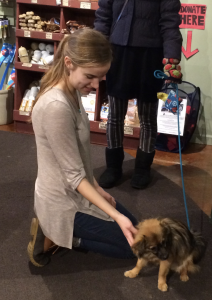
If you have a 6 or 8 foot leash, you could encourage your puppy/new dog to meet people in your neighborhood, if other people are comfortable with that. Praise and encourage them to go say hi, and reward them with a little treat when they return to you. If the dog is a little too nervous, just chat with the people at an appropriate distance, and praise and give treats for any signs of interest. If the dog is very nervous, keep the visit short and reward any check-ins to you by the dog.
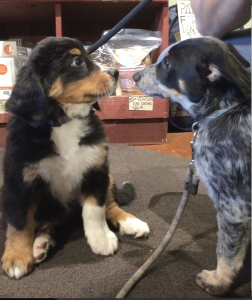 If your puppy has had its second round of vaccines (or is meeting a dog you know is healthy and well vaccinated) you could also allow your dog to meet other dogs in this way. If both dogs are on a 6 foot leash, the humans will be at least 10 or 12 feet apart. Always ask if their dog really likes puppies (not all dogs are keen on them) and with your adult dogs, ask how they do when greeting other dogs on leash (some are great off leash but not on). It’s better they have an uneventful sighting of another dog nearby than a yucky interaction. For puppies, perhaps ask the other owner (especially if their dog seems boisterous) to keep their dog close to them, and allow your puppy to go
 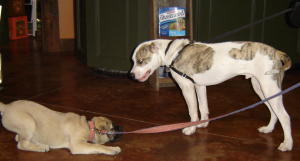 in and out as you cheer-lead her for any little progress forward. This way there’s less of a chance of your puppy becoming overwhelmed and frightened by a bigger dog enthusiastically running up and over her, which could be scary. Your aim is always to have one of two things happen: an event that is positive for them, or one where nothing exciting happens. Some dogs don’t care at all about other dogs, and will ignore the puppy that sniffs at them. Awesome! They interacted with a dog and nothing bad happened! It’s a win. Then they might meet another dog and though the puppy didn’t feel brave enough to approach entirely, nothing bad happened and you praised and were a cheerleader to your puppy and he got a little closer and was rewarded for it by you. Maybe the next dog is pretty awesome and your puppy is interested, yo-yos in and out getting closer each time while you cheered them on. They met and it was pretty fun! Now you’re getting somewhere! If a dog ever is a little scary towards the puppy, use your happy encouraging silly voice and say OK let’s go! Try and jolly the puppy back up again and create some fun on that walk to help them shake it off. Reward the sight of any dog approaching and passing by with a treat or two, to create positive feelings about dogs approaching.
Challenge #3: Normally You’d Have Access to Puppy Classes
Here’s some amazing news if you’re in Portland:
Doggy Business, our absolute favorite training facility, is still doing puppy socialization classes and puppy 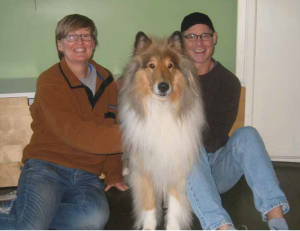 kindergarten!! These classes are currently held without owners present. They’re taught by the owners of Doggy Business, Doug and Meredith. If there’s anyone I would gladly hand over any puppy of mine to, it would be these two people. They’re also doing some virtual training classes online, and can even do one-on-one virtual sessions. These are all really amazing options and I strongly encourage you to take advantage of them. Their puppy socialization classes are amazing and include exposure to things like skateboards and vacuum cleaners, etc.
They mention that “For Play Groups and Puppy Socials, we have added some extra steps to ensure getting into the building, handing off your dog to us, and picking up your dog is as safe as we can make it. Please drop us an email if you have any questions. And, if you have any symptoms of COVID-19 please keep your dog home with you”.
I’m certain that many other training facilities around the nation are adopting similar programs, using apps like Zoom or FaceTime to give you access to advice and training techniques, and I’m quite sure there’s a lot of good (and bad) training advice online. Look for virtual puppy kindergarten classes that emphasize the importance of Positive Reinforcement Training.
Other puppy priorities:
The good news is that if you have time on your hands, you have a wonderful opportunity to work on some important basics
Handling: Now’s the time to get them used to grooming and maintenance activities that will be necessary 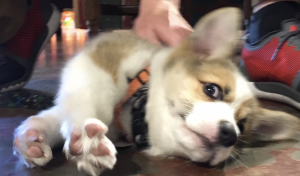 for a lifetime of care. Get your puppy used to you handling her feet (a good time is when she’s drowsy) Touch her toenails, spread her toes and look between them, and do a little massage. When this becomes normal and pleasurable to her, start holding a toe and touching something random to it, like a pencil eraser or a spoon or a bully stick (later this will be nail clippers). Reward this well with a treat or two sometimes (and give her that bully stick). Sometimes bring clippers to the couch and just have them lying around, and when you’ve had good success with other objects, touch them briefly to her toenail and reward it. When you do finally nip the tippy-tip off of one toenail, reward that really well with something amazing! (cheese? A piece of chicken?) and don’t clip any more that day. You never have to cut all nails in one sitting – it’s better to leave on a high note. It’s also best to just take the tips, even if the nails are long. Better to have a positive experience than an accidental bleeding quick. If their nails are long, the quick might be closer to the end than you think. Take the tips regularly with a little time in between to let the quick recede before you take more, and try to take the tips more often in the future to keep them at a good length.
Get into her ears regularly. Massage her everywhere. Inspect her bootie. Get into her mouth frequently and count her teeth. Rub her gums with flavored dog toothpaste (yum!) (no need to brush before she gets her adult teeth, but it’s a very good idea to introduce this idea now. You could even use a piece of gauze with toothpaste on it to rub along her gum line. Don’t mess with her gums when she’s teething.) Make these activities into something she finds normal for you to do. They could be very important in the future to being able to see changes, find lumps, and do cleaning and maintenance of her whole body. You never know when she might get a burr or a cut or a tick, etc. on some part of her body or between her toes and you want her to be amenable to all of these sorts of manipulations.
Developing a puppy’s soft mouth:
This is an important thing to work on right from the first days you have the puppy. A puppy’s bite can be 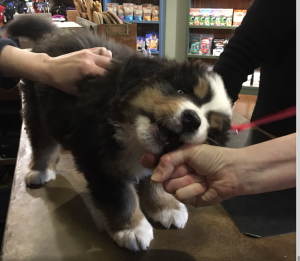 significantly painful, so it’s no surprise that people would start a “no biting” policy from the beginning. However, we feel there are important reasons not to say no mouth at all. Why? Because the early days are the only days that you can help a puppy begin to understand the difference between a gentle mouth and a hard mouth, and the only time that you can create a dog who automatically inhibits the force of his bite later in life. Developing “bite inhibition” means that if he does happen to bite, he is less likely to inflict as much damage as a dog without any automatic bite inhibition. It is critical to keeping people and other dogs safe if he were to ever bite someone. The truth is, any dog, no matter how sweet and trustworthy and gentle, might find themselves in an extraordinary situation. If he were in a dog fight, he might defend himself. Or if he were in a car accident and a stranger reaches into the car to get him out, he may be so stressed that he bites. If he is an old dog and in some sort of very bad pain you are unaware of like undiagnosed bone cancer and a child trips and falls on the dog, the startled dog feeling pain might bite. When a dog grows up with no bite inhibition, these bites could be much more injurious.
Adult dogs with no automatic bite inhibition often take a treat with what feels like a part of your finger along with it. They don’t mean to be a shark, but they never were able to learn how to use a soft mouth with human hands.
Here’s how to do it with your puppies:
You know that soft gentle gnawing that puppies do sometimes? If it’s soft, the adults in the house should allow it for now. When the puppy bears down harder, the most important thing to do would be to get up immediately and walk away. You can say “Oops!” or “Ouch” and just abandon that dog. Eew. Yucky dog. You don’t want to say “no bite”, or hold his mouth, or make him bite his own lip, etc. When you aggress against him, he’s likely to escalate, and then you might escalate, and now everyone’s feelings are hurt and he hasn’t even learned what you needed him to learn. Saying no and keeping the game going is also is a mistake, as the puppy just thinks you’re roughhousing. Instant abandonment is feedback that there’s one thing he can do that abruptly ends your desire to play with him, which is to bear down with his teeth. Even other puppies do this to a degree. Someone in a litter bites too hard and the bitten puppy yelps and stops playing to lick his wounds. If there is one thing (biting too hard) that reliably, consistently ends his playtime, he’s going to start to avoid that. If, when you get up to walk away he follows you nipping at you, just pick him up without much comment (maybe an “Oops – too bad!”) and plop him on the other side of a baby gate for a few minutes. When he’s calm, let him out. You could even try another play session, but if he bites down again, you could have a 2- strikes-and-you’re-out policy. If you have smaller children at home, it’s important that an adult be involved with all play sessions and to have things puppy can bite on like tug toys or stuffed animals. Teach kids that if the dog is getting rough or just too excited to just stand up and “be a tree”, crossing their arms, turning away. If he persists in jumping at the kids to get their attention back, you may then want to put the dog in a short timeout, but If he calms down, they can return to gentle play. Keep an eye out for a puppy that’s had enough and end the playtime on a good note before he gets too wound up. Start a different activity like a walk outside or chewing on something in a quiet spot.
If you’re out in public and the puppy puts his mouth on a stranger you should also calmly end the interaction. “Oops – Time to go.” It’s important that a dog doesn’t think it’s acceptable to goof around with strangers by getting mouthy with them. Playing with a stranger might be fun for that stranger, but later in life a dog putting their mouth on them might not be. A lot of people out there are nervous around dogs, and they might just be litigious, accusing your goofball of maliciously biting them. Best to not develop that habit.
Final Stage: When the puppy is getting better at using a mostly soft mouth, you can start to become a bit more fragile, pretending that even his soft mouth now hurts as well. You’ll be able to get rid of that gentle puppy gnawing mouth and now be tightening your standards – now even a soft mouth on a human hand ends their fun. This way you will be on your way to having a dog that is always soft and gentle with his mouth with all human hands.
The good news:
Despite these Corona virus challenges, you are correct in thinking that y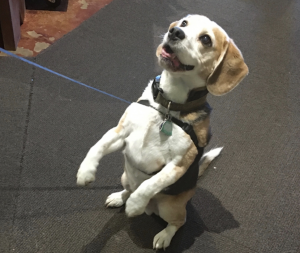 ou really can get a lot of training work done with any dog in your household with this time on your hands.
Teaching new tricks and skills is fun and mentally challenging for both the people and the dogs.
ou really can get a lot of training work done with any dog in your household with this time on your hands.
Teaching new tricks and skills is fun and mentally challenging for both the people and the dogs.
Some ideas: Try Target Training! (this link brings you to an article about what target training is and how we used it as zookeepers to introduce the concept of training to various species in the zoo setting). Maybe target training will enable your dog to learn something useful like retrieving the remote for you or turning off a light switch!. Build an agility course and use targeting to teach them how to move around the obstacles.
Other ideas for fun training: Teach silly tricks like “sit pretty”, being able to go around a tree or other object clockwise or counterclockwise on command, to hop up on something on command, to go under a broomstick or hop over it.
We look forward to seeing all the great new tricks you’ve taught your dogs while you were at home!
This article is part of a series about training puppies/adult dogs (and even tips for cats). Here are links to the others so far:
Tips for New Puppy Owners What a fun time you’ll have! We very much want your new baby to live a long, healthy, happy life, so we thought we’d compile some of the nitty-gritty dos-and-don’ts of puppy care. Socialization, nutrition, our favorite chews, tips on potty training, etc!
What Do They Want? How Should They Get It? (Foundational Thinking For Creating Good Behavior in puppies and kittens! Part One) Often we hapless humans try our best to tell our puppies (and kittens) what we want them to do or especially not do, yet the bad behaviors increase and we struggle to get them to be what we wish they would be, especially when it comes to attention-getting behaviors. I’m here to offer a few rules of thumb for most any behavior you don’t like.
To Treat Or Not To Treat? Foundational Thinking For Creating Good Behavior In Dogs Part 2 : Choose Your Methods of Training Carefully, especially with Reactive/Fearful Dogs.
This is the second article in the series that I call “foundational thinking”, as once you understand how dogs think and learn, and the concepts behind why you use certain methods, you can train just about any behavior you like! I think it contains what I believe to be some of the most important information I can give you about why we use positive reinforcement, and the dangers of using dominance theory and aversive methods especially when dealing with situations that are uncomfortable for dogs.
Do I Always Have To Use Treats? (Foundational Thinking For Creating Good Behavior In Dogs Part Three) A lot of people worry about training with treats.
* Do I have to keep giving them treats for everything for the rest of their lives?
* Aren’t I bribing them?
* I want them to do things because they want to please me.
* I want them to do things right away and I don’t want to have to show them a treat to get them to listen.
These are all good questions. Here’s how to help your dog be able to do what you ask of them the first time you ask, while continuing to build a good relationship.
Drop It!
We’re continuing our puppy series with discussions of common training challenges. It’s so easy to accidentally create a dog that runs away from you when they get a hold of something they shouldn’t have. Wouldn’t you rather they spit something out of their mouth when you approach? You can do it!
Come!
The “Come!” command is one of the very most important things we can teach our dog. A reliable recall is imperative to get them quickly to safety, to recover them if they happen to get out the door, and to proactively remove them from a situation at the dog park that might evolve into trouble. It’s also a wonderful luxury when you are in a safe quiet place to be able to have your dog off leash and know you can get him right back when you want to. Like the command “Drop It!”, it’s easy to accidentally make mistakes when training this behavior that can undermine your success. Here’s how to succeed in training a reliable recall.



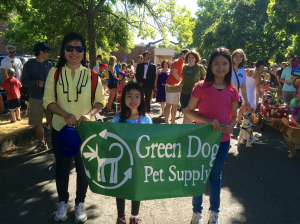
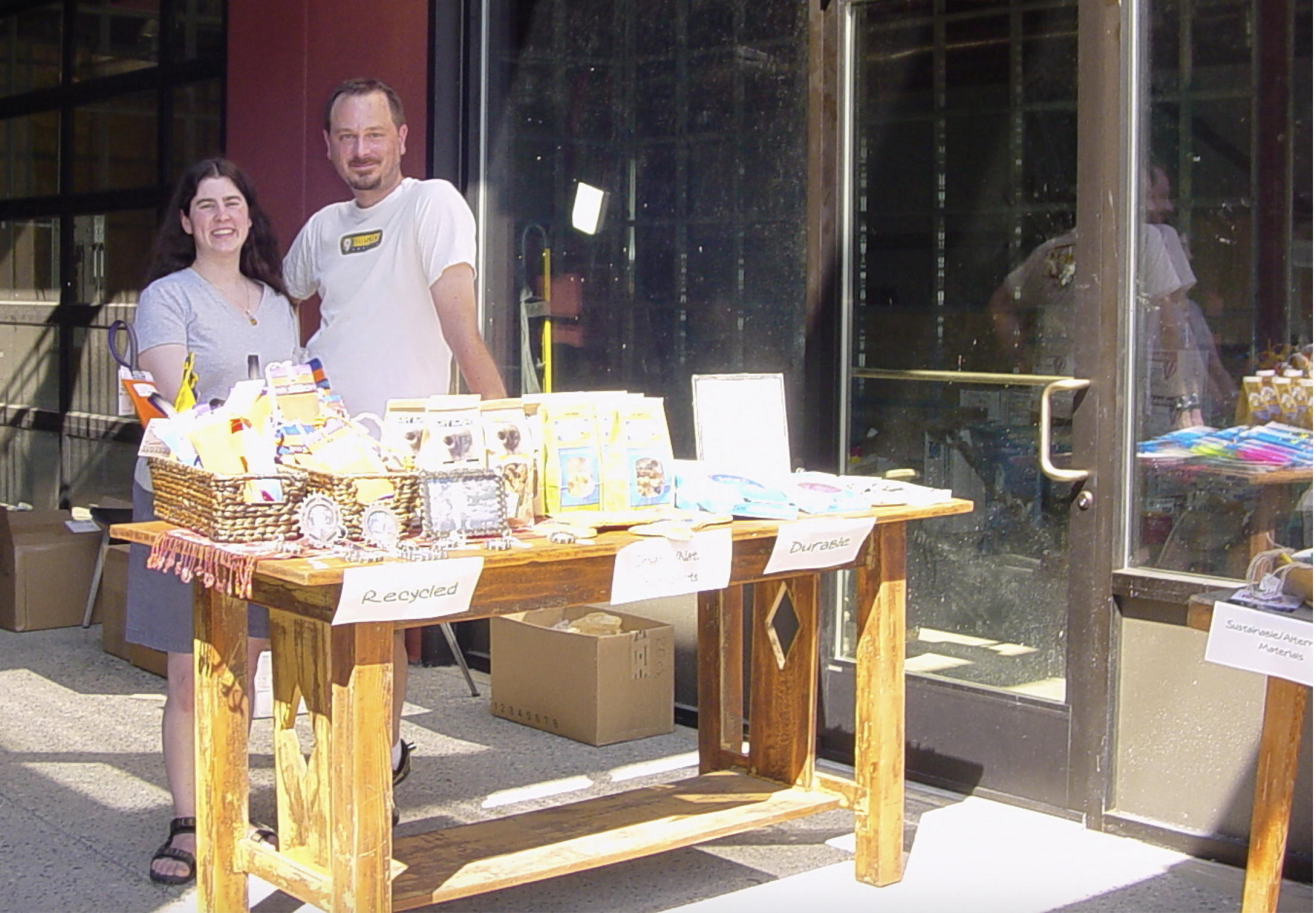
 We do want to tell you about a potentially valuable resource we’d like to share with you. We’ve donated our booth to Force Free Oregon,”A safe, reliable place for Oregon communities to find credentialed animal care professionals who use scientifically-proven force-free training, behavior modification, and animal handling techniques”. Trainers will be staffing the booth, including the amazing Lorena Jasis-Wallace, a trainer at Synergy Behavior Solutions, a veterinary behavior practice and training facility in NW Portland. They specialize in reactivity, aggression, phobias, anxieties, and other behavior issues. Another trainer, Hayley Martinez, owner and trainer of Nakama Dog Training will also be there. She works with puppies, newly adopted dogs, adult dogs in need of basic manners, as well as some reactivity and shy dog cases. There may even be other Force Free member trainers that spend some time in the booth.